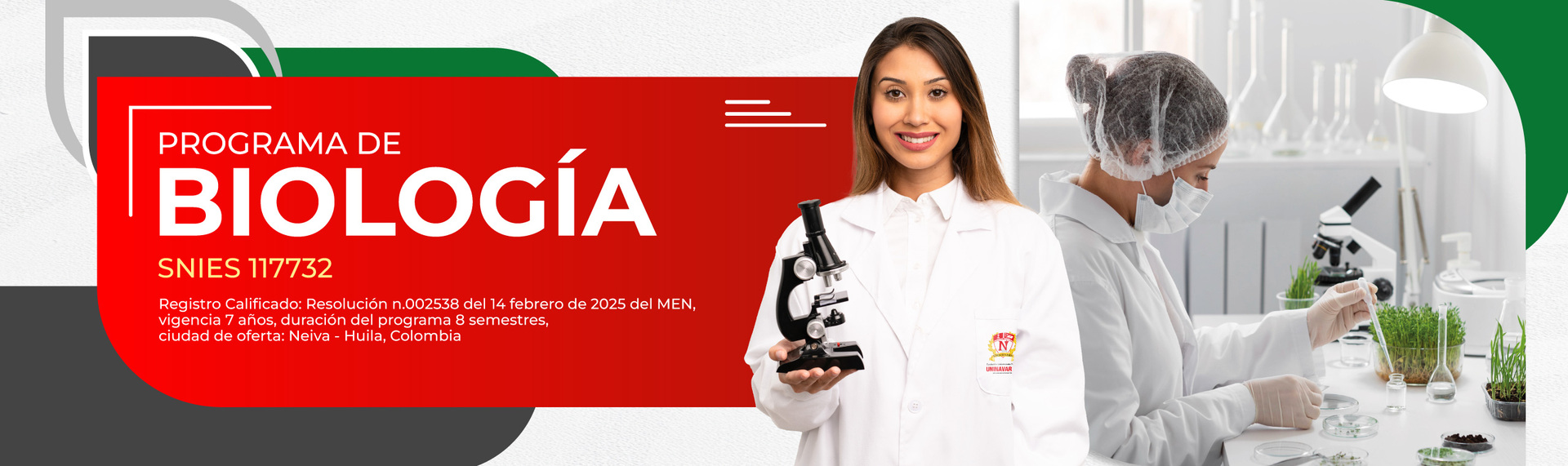
| Title awarded: Biologist |
| SNIES code: 117732 |
| Qualified Registration: Resolution No. 002538 of February 14, 2025, effective for 7 years. |
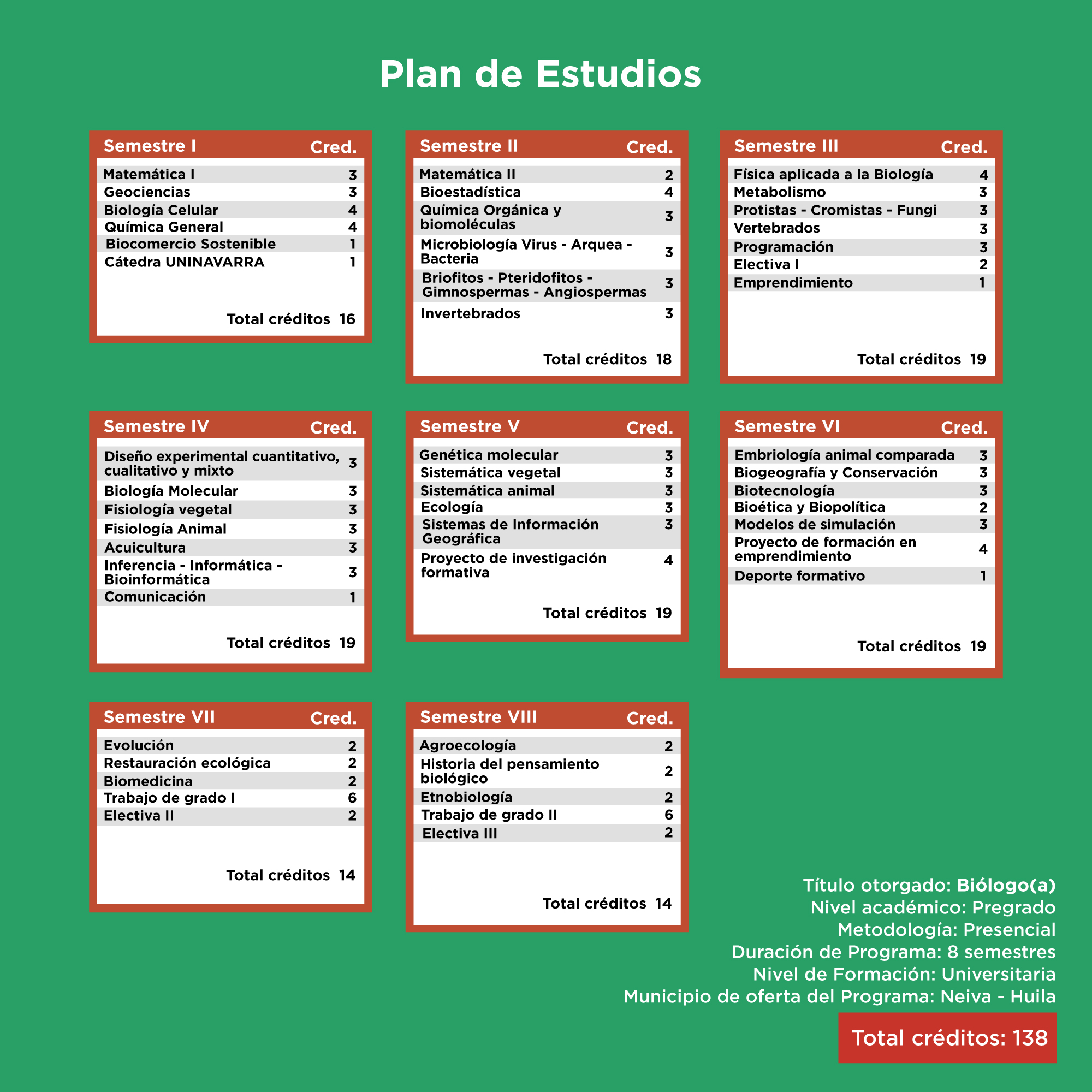
| Duration of the Program: 8 semesters |
| Number of academic credits: 138 |
| The program is attached: Faculty of Health Sciences and Basic Sciences |
| Academic Level: Undergraduate |
| Level of training: University |
| Modality: On-site |
| Location: Neiva, Huila, Colombia |
| Periodicity of admission: Annual |
| Contact us: +57 318 071 5286 |
Presentation of the program
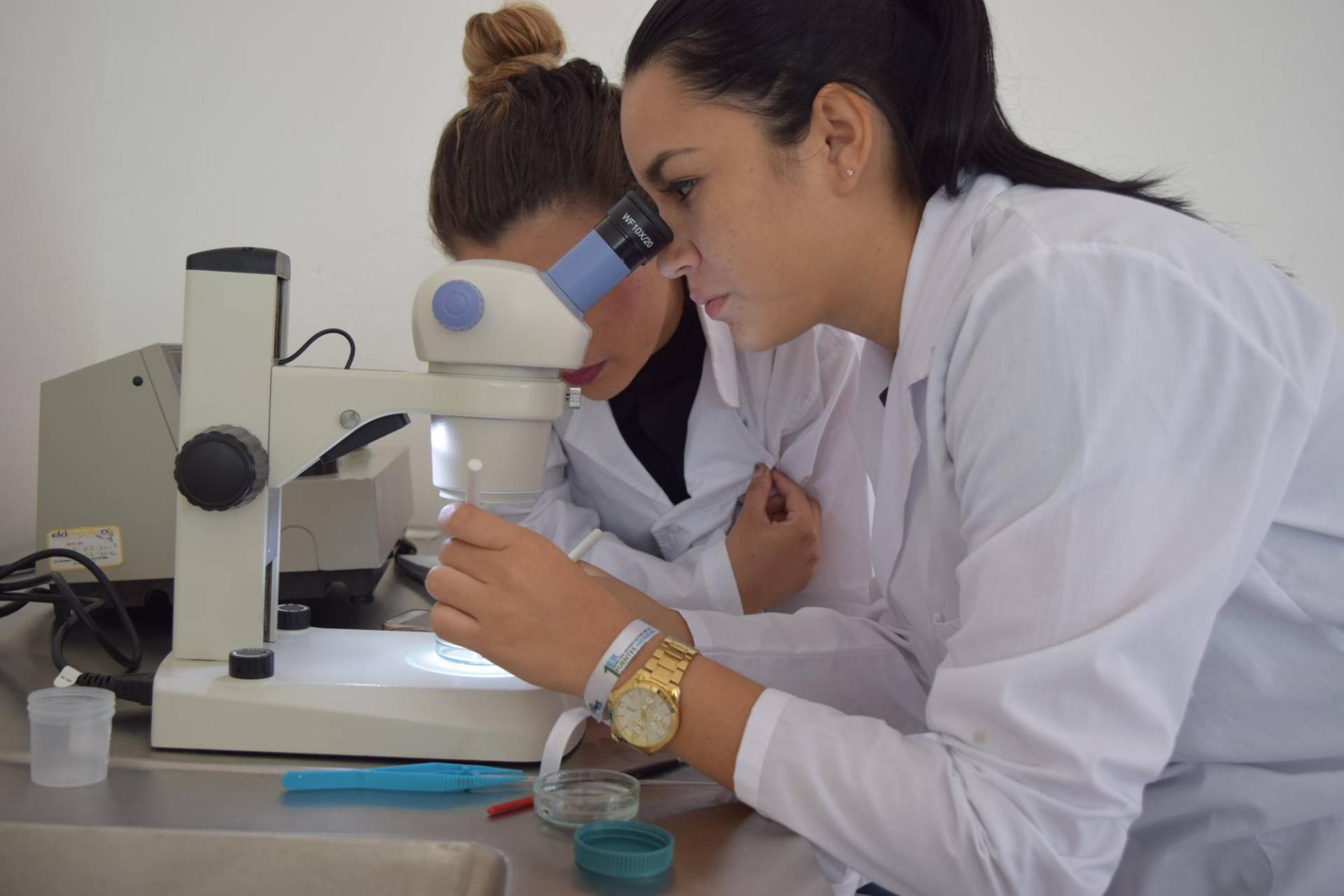



The Biology program of the University Foundation Navarra UNINAVARRA, is framed in the Law 30 of December 28, 1992 in its Chapter III -fields of action and academic programs- articles 7, 8 and 9 where its condition of undergraduate is specified. This program is conceived as an option to address problems located in large nuclei where the basic sciences, applied biology, computational biology, genetics and evolution, molecular biology and ecosystem, among others, stand out. Thus, the program aims at the formation of a professional biologist with criteria of excellence articulated to the institutional mission and vision and its main purpose is focused on the formation of biologists with a solid disciplinary, social, ethical and entrepreneurial structure with the capacity to contribute to the solution of local, regional and national problems.
The UNINAVARRA biologist will be a professional committed to research and the construction of interdisciplinary options that contribute to the improvement of natural, social and cultural conditions within the framework of sustainable development.
The program incorporates as an innovative element its interdisciplinary view of the problems, articulating the disciplinary, technological, social and ethical aspects, through the development of formative research projects and entrepreneurship, which will contribute to the solution of local and regional problems.
To train biologists within the framework of academic excellence, with a solid social, ethical and entrepreneurial structure, with the capacity to contribute to the solution of problems in the field of biology from a scientific, economic, political, research and innovative stance within the framework of sustainability, to contribute to the development of the region and the country and to promote an impact at the international level.
The UNINAVARRA Biology program will be recognized as a vanguard option in the formation of professional leaders in projects that improve the living conditions of the region, linked to international programs and projects with a spirit of service and social responsibility. Its graduates will be citizens who transform the disciplinary, cultural and social environment, from the recognition of environmental potentials and the recognition of the "other" as an equal.
Admission requirements
- Personal profile where personality traits of the applicants are evaluated to verify affinity with the entrance profile of each program.
- Intellectual profile where the degree of knowledge is evaluated and based on the State Aptitude and Knowledge Tests of the Colombian Institute for the Promotion of Higher Education ICFES, minimum admission scores will be established for each program.
- Attitudinal profile determined in interview processes in which the Program Director will determine the affinity between the student and the formative requirements of the program.
Applicant Profile
General admission profile and admission requirements:
Admission to UNINAVARRA is free and voluntary, by processes of enrollment of applicants according to their vocation. Admission to the Biology Program of UNINAVARRA will be based on four profiles:
- Personal profile: where applicants' personality traits are evaluated to verify affinity with the program's entry profile.
- Intellectual profile: where the degree of knowledge is evaluated based on the Aptitude and Knowledge State tests of the Colombian Institute for the Promotion of Higher Education (ICFES).
- Attitudinal profile: determined in the interview process in which the Program Director will determine the affinity between the student and the formative requirements of the program.
- Psychological profile: where psychometric personality tests will be applied to evaluate this profile from a clinical perspective in order to ensure the applicant's affinity and stability with the program to be studied.
Graduate profile
The Biology graduate profile is articulated with the general profile of the UNINAVARRA graduate established in paragraph 2.8 of the PEU - Agreement 006 of 2010, which defines it as "a conjunction of three fundamental elements for the development of the human being: personal, professional and occupational profile".
- As a person: UNINAVARRA graduates are integral human beings, aware of their life project and sensitive to the problems of society, being an actor in its transformation.
- As a professional: understands that everything he has learned in his training has a clear and specific utility in the development of his profession.
- On the occupational side: is objectively and demonstrably qualified in a series of competencies recognized by the productive sector and the institution.
UNINAVARRA graduates are critical and proactive. They propose solutions to specific problems by applying science and technology. They are fully aware of the implications of their profession and their ethical vision is based on deontological training and classroom experience. Seeks to understand social phenomena as actions that guide the destinies of their community, on which they must have a position and an opinion that can and must be heard.
Specific profile of the UNINAVARRA Biologist
The graduate profile of the UNINAVARRA BIOLOGIST aims at a professional with a high disciplinary and research component who will be able to:
- Identify and contribute to the solution of problems in different fields of biology.
- To learn about Colombian ecosystems in terms of biodiversity, conservation and restoration.
- Project ecosystem management under sustainability frameworks.
- Critically analyze environmental policies and propose beneficial transformations.
- Generate relevant productive projects according to identified needs.
- Use information and communication technologies to solve biological problems.
- Adapting to the needs of a globalized world through educational innovation
From the human point of view, the UNINAVARRA Biologist will be an integral human being, critical, proactive, with an autonomous life project, sensitive to environmental and social problems, enterprising and with a view to personal and social growth.
Professional profile
The Biologist graduated from UNINAVARRA will be an integral professional who will be able to work in the following fields:
- Research: In public or private entities such as biological analysis laboratories, science institutes, natural settings such as parks, nature reserves, strategic ecosystems or fragile ecosystems.
- Environmental management: As director, advisor or manager of innovative projects aimed at improving ecosystem conditions, sustainable management of biodiversity, conservation and restoration where vulnerable communities have a direct benefit.
- Bioinformatics: As a developer of computer programs that allow modeling biological situations that support projects in different fields of biology.
- Specialized areas: Leading or supporting programs that have components in toxicology, biotechnology, biomedicine, agroecology or aquaculture.
- Entrepreneurship: As a manager of self-managed companies to maximize benefits to the communities, the region and the entrepreneur, including a relevant, viable, ethical and economically possible position.

Luis Andres Sandoval Lozano
Teacher

Maria Eugenia Hernandez Valenzuela
Teacher
UNINAVARRA facing the world
We have an Internationalization Policy "UNINAVARRA FACING THE WORLD"which aims to offer the academic community a bridge between the local environment and the globalized world. Through its lines of action, it provides opportunities for interaction with the national and international environment in classroom and online mode, where you can live training experiences in other contexts, interact with people from different cultures, learn about the global dynamics and its social, cultural, economic, environmental changes, among others; enhance your career with national and international projection and strengthen your training as a global professional and citizen of the world.
Lines of action and opportunities:
- International Cooperation Management: Agreements, alliances, joint projects and networking with more than 200 institutions from different countries around the world such as Argentina, Brazil, Canada, Chile, Spain, United States, Italy, Mexico, Peru, among others.
- Academic Mobility Management: Student exchange opportunities during one or two academic periods throughout the development of the student's academic program in different types of mobility such as: Academic exchange (taking subjects), short course, internship, practicum, mission, research stay, observership and degree modalities. Teaching mobility as national and foreign visiting professors in your classroom.
- Multiculturalism and Multilingualism Management: Activities that contribute to the development of intercultural competencies and communicative competence in a foreign language, mainly English as a universal language.
- Management of the Internationalization of the Curriculum: Joint classes with other institutions through mirror class methodology or COIL (Collaborative Online International Learning).
More information: https://uninavarra.edu.co/internacionalizacion/
Related Programs