
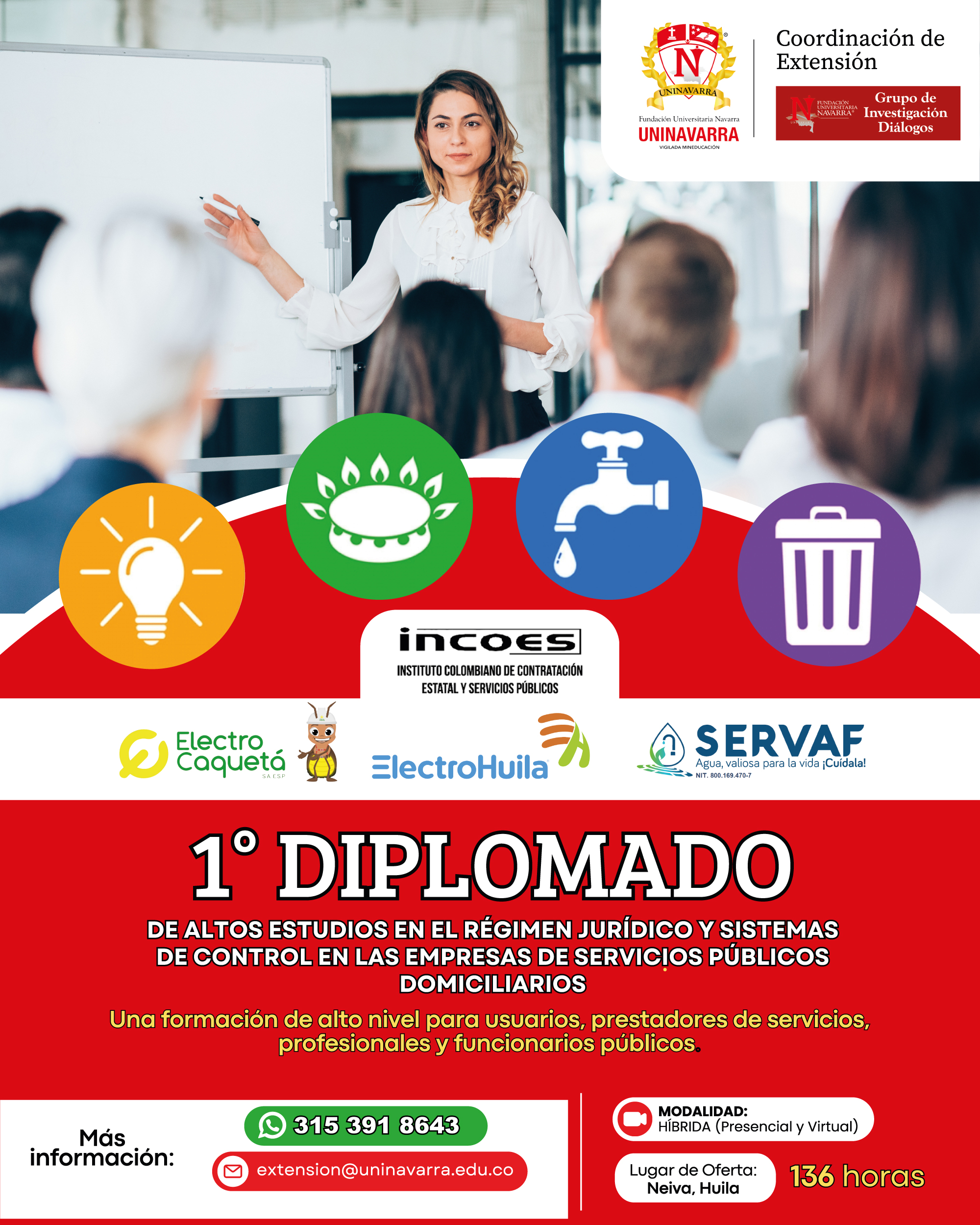
I Diploma of Higher Studies in the Legal Regime and Control System in Household Public Services
Duration: 12 weeks
Investment:
Professionals and employees: $1,500,000
Students: $1.000.000
Professionals and employees: $1,500,000
Students: $1.000.000
Modality: Hybrid (face-to-face and virtual)
Quotas: Unlimited
Hourly Intensity: 136 hours
Faculty: Humanities and Social Sciences
Allied Entities:
Electrificadora del Huila, Electrificadora del Caquetá, Empresa de Servicios de Florencia S.A E.S.P - Servaf, Instituto de Consultoría y Especialización - Incoes.
Electrificadora del Huila, Electrificadora del Caquetá, Empresa de Servicios de Florencia S.A E.S.P - Servaf, Instituto de Consultoría y Especialización - Incoes.
Program Presentation
The Fundación Universitaria Navarra - UNINAVARRA presents this diploma course with the purpose of training and updating professionals, users and providers in the legal regime and control system of domiciliary public utilities, with emphasis on current regulations, social and institutional control, and its relationship with the objectives of sustainable development.
The Fundación Universitaria Navarra - UNINAVARRA presents this diploma course with the purpose of training and updating professionals, users and providers in the legal regime and control system of domiciliary public utilities, with emphasis on current regulations, social and institutional control, and its relationship with the objectives of sustainable development.
General Objective
Provide users and service providers with updated information on the legal regime and the control system for residential public utilities.
Provide users and service providers with updated information on the legal regime and the control system for residential public utilities.
Specific Objectives
- Identify the constitutional and legal principles and values that regulate Public Utilities.
- To update knowledge on the legal regime (legal, regulatory, doctrinal and jurisprudential) in the provision of Public Utilities.
- To know the institutional and social controls aimed at protecting the users of residential public utilities.
- To understand the methodologies, regulations and formulas of the Public Services tariff system within the framework of constitutional and legal principles.
- Generate social awareness among users and providers of domestic public utilities within the framework of sustainable development policies (SDG 6: Clean water and sanitation; SDG 7: Affordable and clean energy).