
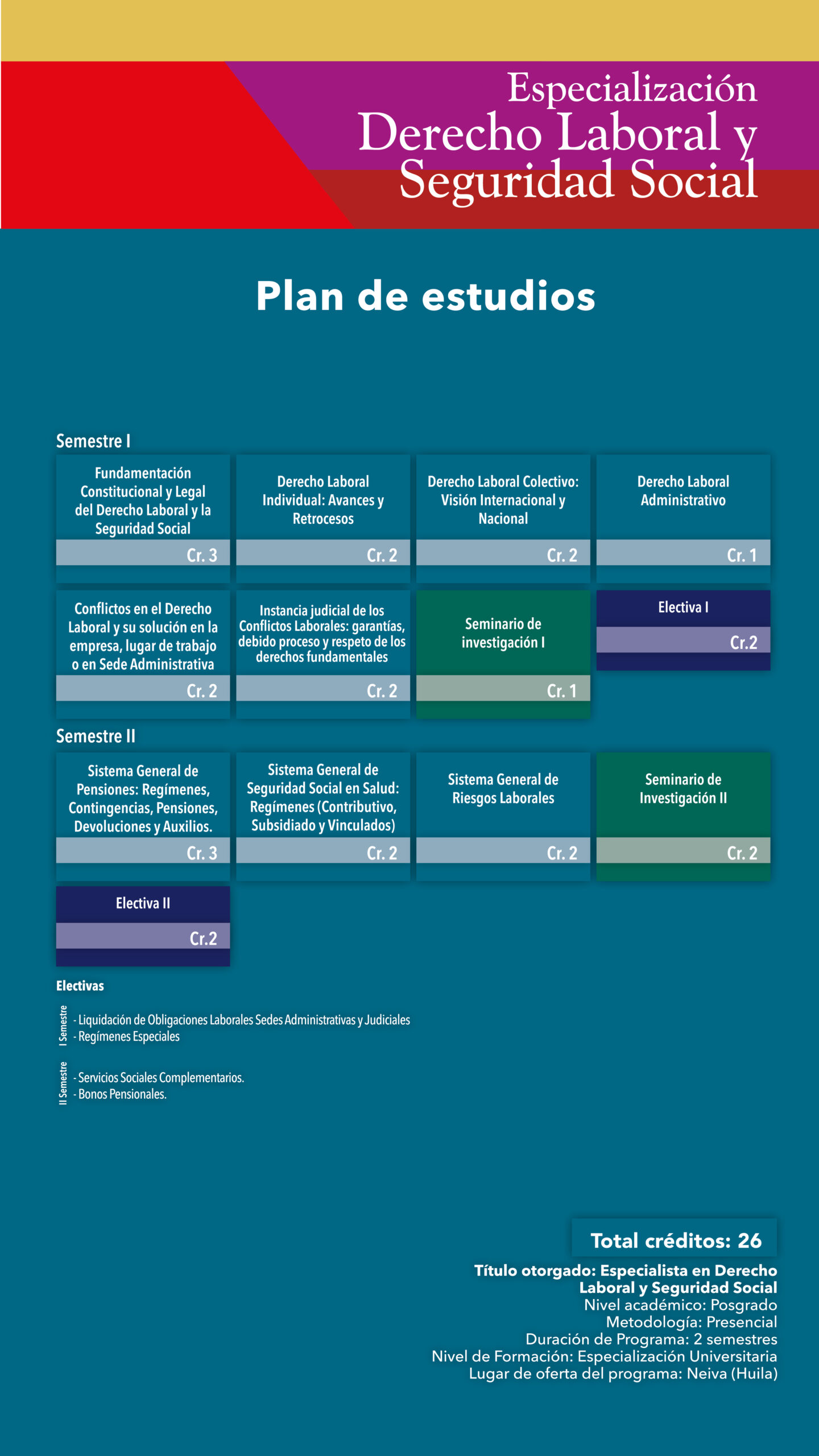
| Title awarded: Specialist in Labor Law and Social Security |
| SNIES Code 110228 |
| Qualified Registration: MEN Resolution No. 7360 of April 28, 2021, effective for 7 years. |
| Duration of the Program: 2 semesters |
| Number of academic credits: 26 |
| The program is attached: Faculty of Humanities and Social Sciences |
| Academic Level: Postgraduate |
| Level of training: University Specialization |
| Methodology: On-site |
| Location: Neiva, Huila, Colombia |
| Periodicity of admission: Semiannual |
| Contacts: +57 318 071 5286 +57 317 514 1730 |
Presentation of the program

The purpose of the Specialization in Labor Law and Social Security is to address the most relevant topics in this discipline and to train specialists with the capacity to intervene in the different conflicts that arise in individual labor relations and collective labor relations, after addressing the constitutional and legal references, within the framework of international human rights law, the International Labor Organization, the sources of international labor law emanating from the United Nations, freedom of association and collective bargaining.
It is also the purpose of the Specialization to train specialists with knowledge of the General Pension System, the General Health Social Security System, the Labor Risks System and Complementary Social Services.
Who is the target audience?
To all professionals in any area of knowledge who are interested in the subject of specialization or are engaged in the practice, study or defense of Labor Law and Social Security.

The specialist in Labor Law and Social Security will be a professional with a legal, humanistic, political, ethical, conciliatory and enterprising background, with the ability to prevent, analyze and resolve, in a peaceful manner, practical problems and theoretical dilemmas with responsibility and commitment, which arise with workers, employers, entrepreneurs and users of Social Security.

Since the program is interdisciplinary, it is necessary to establish some occupational profiles for non-lawyer specialists and other very specific ones for lawyers, as follows:
- Legal professionals, specialists in Labor Law and Social Security, will have the competencies and skills to work as litigators, conciliators or arbitrators, judges, magistrates or judicial assistants; advisors or consultants in processes derived from labor or social security conflicts; as members or external advisors of companies, unions and entities providing social security services. They will also have the knowledge to focus on the prevention of legal risks in labor-employer, union-company and user-social security relations.
- Professionals in other disciplines or professionals with work experience in the area, specialists in Labor Law and Social Security will have competencies and skills that will allow them to better practice their profession, which will contribute to minimize the legal risks derived from labor law and social security relations; they may work as advisors, consultants or employees of companies or public or private entities that have workers or unions; as legal representatives, managers or owners of companies; as assistants to the justice system, or as leaders in human talent offices.

UNINAVARRA facing the world
We have an Internationalization Policy "UNINAVARRA FACING THE WORLD"which aims to offer the academic community a bridge between the local environment and the globalized world. Through its lines of action, it provides opportunities for interaction with the national and international environment in classroom and online mode, where you can live training experiences in other contexts, interact with people from different cultures, learn about the global dynamics and its social, cultural, economic, environmental changes, among others; enhance your career with national and international projection and strengthen your training as a global professional and citizen of the world.
Lines of action and opportunities:
- International Cooperation Management: Agreements, alliances, joint projects and networking with more than 200 institutions from different countries around the world such as Argentina, Brazil, Canada, Chile, Spain, United States, Italy, Mexico, Peru, among others.
- Academic Mobility Management: Student exchange opportunities during one or two academic periods throughout the development of the student's academic program in different types of mobility such as: Academic exchange (taking subjects), short course, internship, practicum, mission, research stay, observership and degree modalities. Teaching mobility as national and foreign visiting professors in your classroom.
- Multiculturalism and Multilingualism Management: Activities that contribute to the development of intercultural competencies and communicative competence in a foreign language, mainly English as a universal language.
- Management of the Internationalization of the Curriculum: Joint classes with other institutions through mirror class methodology or COIL (Collaborative Online International Learning).
More information: https://uninavarra.edu.co/internacionalizacion/